Tuesday, January 27, 2009

Michał Olbert Gliwice

A fantastic animation


The newspaper El Mundo "we have come to see some amazing animations on any subject. In these days has published one on the color that you can not stop watching, describes the phenomenon of tanning and the different colors of skin and eyes.

View animation

Monday, January 26, 2009

How Much Does Sewn In Extension Service Cost?!


Today is the last school day and must complete the following task:
visit: http://www.metmuseum.org/toah/hm/11/eu/hm11eu.htm , select a region in Europe. Then you do the following:
1. Identify the three major historical events according to the timeline.
2. Explain why these events are important (causes, effects, etc)
3. Select one of the paintings of this period and analyze it to answer the following: a.
Describe the painting in your own words, objects or people are in the painting, why are they important? B.
What message or meaning you think the artist expresses in paint? C.
How to connect the painting with the historic period of the time line?

Thursday, January 22, 2009

Ontario License Plates Ski Doo

2009, a year very scientific.


2009 is a year that are held two commemorative events related to Science, the first of which is twofold, since it is simultaneously celebrated the 200 th birthday of Charles Darwin and the 150th of the publication of his book "The Origin of Species" which exposed what is now known as "Theory of Evolution." The second is the statement by the UN as the "International Astronomical Year, coinciding with the 400 th anniversary of the first astronomical observations of Galileo Galilei.
Both celebrations will involve an enormous range of scientific activities across the globe and especially in the case of Darwin in the UK where he has been given a special meaning.
Here you have some links so you can get information on both events:

  • International Year of Astronomy:
  • Spain, Argentina , Mexico , Chile, Uruguay , UNESCO .
  • will also
2009 the International Year of the Gorilla (English ).

Finally, although leaking the contents of this blog, I can not resist mentioning that 2009 will also hold some very important anniversary for music fans, such as the 250 th anniversary of the death of Handel and the 200 º anniversary of the death of J. Haydn and the 200 th anniversary of the birth of F. Mendelssohn. I leave as a tribute to Handel's musical card that contains a piece that owes much of its popularity to its use as an anthem of the European Champions League Football. Hope you enjoy it.


Monday, January 19, 2009

Enlaged Liver And Gallbladder Polyps

Darwin in the cinema.


Among the celebrations of the 200th birthday of Charles Darwin who carried out this year that just started is the possible release autumn coming from a British film will be called Creation (Funny name for a film about the father of the Theory of Evolution). The British director is Jon Amiel and its protagonists will Paul Bettany in the role of scientist and Jennifer Connelly (her real-life wife) on his wife. Apparently the biopic (biopic) will focus more on the influence that the wife was very religious, in the development and publication of "Origin of Species " in the scientific works of English naturalist. The script is inspired by a book by a great-grandson of Darwin, Randal Keynes, " Annie's box (the box of Annie), which describes how the death of the tenth anniversary of Darwin's daughter, Annie, made him change his conception of God and the world. No film will therefore be a very scientific but, in short, be a matter of seeing it is also very interesting to see how the lives of scientists and the mo historical moment in which I can deal had largely to do with their discoveries.
Anyway this is not the first time that Darwin looks at movie screens or TV, there is a call 1972 film "The Darwin adventure" in 1
the BBC produced 978 TV series "The Voyage of Charles Darwin" and in 1993 the British director Peter Greenaway produced for French television a play called "Darwin" .
of curiosity, opened last year "Evolution: The Musical! a production well away from the science but part of the evolution-creation debate to make a crazy play, at least from a scientific standpoint.
To conclude this post and to top it with a smile I leave you with a video that shows how the theory of evolution has come on the screen to the most unlikely characters, hope you have fun ...


Fishing Channel Nilesat

Hi everyone!

Welcome to this new space, another child of "The Biology Web Easy" or rather the father that begat . Perhaps this is the most personal part of this educational mini-project slowly but surely, took part of my free time and many high school students from Spain and English-speaking America. While
"The Web ..." has the contents of 4 º ESO, made by me and the other two posts "The news of the web ..." and "The videos of the web ..." The filled in with current news and related videos with them, this new blog is intended to be less academic, though no less scientific and more open to everything that moves around to Biology and to a lesser extent the rest of science for both students and educators and people from all interested in the scientific world can be a pleasant place in which to read, learn and, of course, to think about things that are offered here.
not intend to use this platform as a speaker for my own social or political ideas but for presenting and discussing facts about science in general and biology particularly informative purpose even (let me professional deformation) teacher of science.
not extend over the first post, I hope this modest contribution will serve to take another grain of sand in the understanding of science by a company but remains fascinated by the scientific and technological advances give them back when to learn its principles, to understand that even begrudge develop financial support for their work.

Wednesday, January 14, 2009

Should You Order A Ski Boot Smaller Or Larger


What other regions are involved?
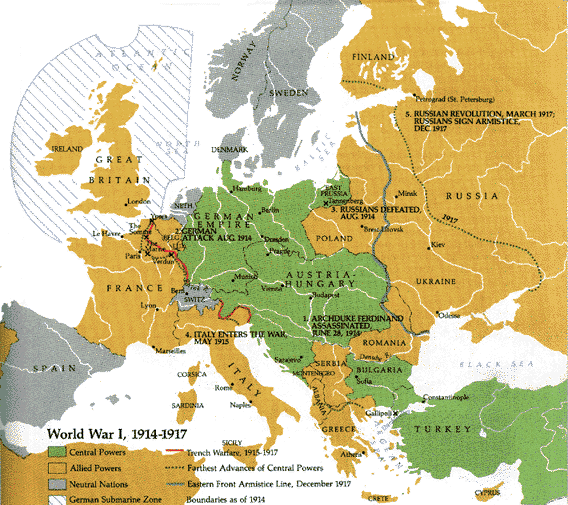
The Allies hoped to take a region of the Ottoman Empire called the Dardanelles. The attack failed with heavy loss of life. Most successful operation was led by British officer TE Lawrence, who organized an Arab revolt against Ottoman rule. As a result, the Allies were able to capture several major cities in southwest Asia. Japan captured German colonies in China and the Pacific Ocean. The Allies also captured three of the four German colonies in Africa. The British used their powerful naval forces to block all supplies to Germany. The Germans responded by increasing its submarine attacks on ships bringing food and supplies to the Allies. It was an unrestricted submarine warfare. This meant sink without warning any vessel in waters around Britain. When U.S. ships sunk and lives lost, the American people are angry. Then the British intercepted a secret message from Germany to Mexico. The message called on Mexico to be allied to Germany. In return, he offered help to recover land lost in war with the United States in 1840. In April 1917, the U.S. Congress declared war on Germany.
What happened in countries at war?
1917, the war had killed millions. Drastically changed the lives of millions of others: both the general population and soldiers. Called the Great War was a war. He demanded all the resources of countries at war. The government took control of factories. Determined what to produce and in what quantity. Moreover, governments imposed rationing. This limited the amount of food and other products. Thus, the hosts could have the necessary supplies. Governments used propaganda to support the war. Also took measures to curb dissent, ie, opposition to the war. With so many men in the army, women played important roles in the economies of countries at war. They worked in factories, offices and shops. Built aircraft and tanks, grew food and made clothing. These changes had an impact on attitudes about the type of work they could do for women.
Why the Allies won?
In 1917, the United States entered the war and left Russia. The Tsar lost popular support because of the suffering experienced by the war. In March, abdicated. The new government wanted to continue the war but the army refused. A few months later, revolution broke out. The Communists took power. They quickly signed a treaty with Germany and gave large tracts of land for peace. In March 1918, Germany launched a final attack. Again rose to near Paris. But the soldiers were tired and supplies were scarce. Allies-now-fresh American troops drove the Germans. Bulgaria and the Ottoman Empire surrendered. In October, a revolution overthrew the Austro-Hungarian emperor. In November, Kaiser Wilhelm II had to abdicate. The new government signed an armistice, an agreement to stop the war. On 11 November 1918, Europe finally reached peace.
VOCABULARY:
unrestricted submarine warfare Using submarines to sink any ship without warning
unrestricted submarine warfare to sink submarines and Stock Using ship
Without Warning war war in which countries use their resources to
war total war War Countries in Which Their use all resources for the war rationing
Control of quantity and kind of rationing products
Control of the Amounts and kinds of goods people
propaganda Can Have Information part designed to convince
One-sided propaganda Information Design to persuade
armistice agreement to stop fighting
Armistice Agreement to stop fighting
TASK, TASK: answer two questions in English and two English question:
1. What regions outside Europe were affected by war?
2. Name three ways the war affected everyday life.
3. What were the final problems faced Germany and Austro-Hungary?
4. Describe the escalation of World War I.
5. Identify how wartime governments ESTABLISHED Economies.
6. Summarize how the Allies pushed to victory.

Monday, January 12, 2009

Cartier Trinity Pricing


Why so many nations involved?
The alliance system made the war between Austro-Hungary and Serbia in a major war. Russia moved against Austro-Hungary. He thought that Germany would support Austria-Hungary. Therefore, Russia has also launched his troops against Germany. Germany declared war on Russia. Shortly afterwards, also declared war on France, an ally of Russia. Germany had a plan to win the war on both fronts. It was the Schlieffen Plan. Demanded a quick advanced on France, its swift defeat and then face Russia in the east. To capture France quickly, Germany moved through Belgium, which was a neutral country. Britain was outraged and declared war on Germany. France, Britain and Russia were called the Allies. After they were joined by Italy, which broke with Germany and Austro-Hungary. Bulgaria and the Ottoman Empire joined Germany and Austro-Hungary. They called the Central Powers.
What kind of war fought?
After the German army came close to Paris, France strengthened their defenses and stopped to Germany in September 1914. Both sides threw themselves into a bloody fight. The soldiers dug deep trenches into the ground. Began trench warfare. When the soldiers were leaving the trenches to jump over enemy lines, they faced powerful weapons. Machine guns, tanks, poison gas and artillery killed hundreds of thousands of soldiers. This is how he fought in France, called the Western Front.
What happened on the Eastern Front?
The war on the Eastern Front was more movement at first, but was equally destructive. The Russian armies attacked both Germany and Austro-Hungary. They had some victories at first but were rejected in both places. One reason was that Russia had not fully industrial economy. Could not supplying troops. However, Russia had a huge population and could send millions to war. The large Russian army was a constant threat to Germany and prevented him from applying all their resources against the Allies in the West.
VOCABULARY:
Schlieffen Plan Plan German to win the war on both fronts
Schlieffen Plan Germany's plan for winning the war on two fronts
Allies Britain, France, Russia and other nations that fought together
Allies Great Britain, France, Russia, and Other Nations Who Fought On Their Side
Central Powers Germany, Austro-Hungary and other nations that fought by his side
Central Powers Germany, Austria-Hungary, and Other Nations Who Fought On Their Side
trench warfare fights from trenches dug on the battlefield
from trench warfare trenches Fighting dug in the Western Front battlefield
region of northern France where there were many battles
Western Front Region of northern France WHERE much fighting Took place
Eastern Front Region along the border between Germany and Russia where made many battles.
Region Along Eastern Front German-Russian border fighting WHERE much
Took Place TASK / JOB, repond two questions in English and two in English:
1. Who were the Allies and Central Powers by whom?
2. How was the war on the Western Front?
3. What weaknesses and strengths had Russia?
4. Describe the reaction to Austria's declaration of war.
5. Summarize the military events on the Western Front.
6. Explain the progression of the war on the Eastern Front.

Thursday, January 8, 2009

Business Object Xi Scheduling


Why not lasting peace in Europe?
Many people in Europe joined with groups who wanted peace. But several factors led to war. One such factor was nationalism, a deep sense of attachment to one's nation. Nationalism united people of the countries. He also created competition between them. By 1900, six nations were rivals for power in Europe. They called the Great Powers, were: Germany, Austro-Hungary, Britain, Russia, Italy and France. Competed economically and neighboring lands. Imperialism was another factor that contributed to the war. France and Germany wanted to control parts of Africa. Were on the brink of war twice in the early 20. Distrust was a huge problem. The third factor that led to war was the arms race. Every country in Europe except Britain-shaped a huge army. Glorify war and prepare for battle is called militarism.
What caused fear among the countries?
The growing rivalry was that nations make military alliances. The Prussian chancellor, Otto von Bismarck, feared that France wanted revenge for his defeat in the Franco-Prussian War. Decided to isolate France. In 1879, he formed the Triple Alliance with Austria-Hungary and Italy. Also signed a treaty with Russia. Kaiser Wilhelm II of Germany did not want to share power with Bismarck. Forced him to resign and implemented its own foreign policy. Let expire the agreement with Russia. Russia sided with France soon. This alliance meant that Germany would have to fight enemies on its borders of East and West if there was war with either country. Wilhelm II then prepared to increase the German naval force. Britain was alarmed. He began building more ships. Also entered the Triple Entente, an alliance with France and Russia. The six great powers formed two teams: Germany, Austro-Hungary and Italy against Britain, France and Russia.
What role did the Balkans in the increase of tension?
Meanwhile, it created problems in the Balkans, southeastern Europe. The Ottoman Empire controlled the region, but it was crumbling. Both Austria-Hungary and Russia wanted parts of their land. The kingdom of Serbia was also in this region. Wanted to control other Slavic peoples living in the Balkans. In 1908, Austro-Hungary seized Bosnia and Herzegovina. These lands were Slavic. This action enraged the Serbs. But their Russian allies were unwilling to support them and withdrew. In 1914, the situation changed. Serbia obtained land in other parts of the region and felt strong. Austria was concerned that Serbia would interfere with their control of Bosnia and Herzegovina. In June 1914, a Serb assassinated Archduke Franz Ferdinand, heir to the Austro-Hungarian throne. Austro-Hungary declared war on Serbia. Russia came out in defense of Serbia. Soon almost all of Europe was at war. VOCABULARY

militarism Glorification of war and preparation for taking
Glorifying war and militarism Preparing for it
Triple Alliance military agreement between Germany, Austro-Hungary and Italy
Triple Alliance Between Germany Military Agreement , Austria-Hungary, and Italy
Kaiser Wilhelm II German Emperor Kaiser Wilhelm II
Emperor of Germany
Triple Entente military agreement between Britain, France and Russia
Military Triple Entente Agreement Among Britain, France, and Russia
TASK / TASK, answered two questions in English and two in English:
1. Name three factors that led to war.
2. Name two groups of nations were formed.
3. What was the role of the Serbs at the start of World War I?
4. Identify the Political and military forces in Europe That Took root in the late 1800s.
5. List the Countries That Compare The Triple Alliance and the Triple Entente.
6. Summarize the events in September That World War I in motion.

Red Wine On Velour Sofa


WORLD WAR I,
THE GREAT WAR,
LA PRIMERA GUERRA MUNDIAL (1914-1918)
An assassination in the Balkans sparked the outbreak of World War I. Millions died during the war, which also led to a revolution and Communist rule in Russia. The war settlements redrew the map of Europe and imposed heavy penalties on Germany.
The Road to World War I
Competition over trade and colonies led to the formation of two rival European alliances—the Triple Entente of Great Britain, France, and Russia; and the Triple Alliance, consisting of Germany, Austria-Hungary, and Italy. Repeated crises over Serbian claims on the Austro-Hungarian region of Bosnia revealed the dangers inherent in these alliances. Austria-Hungary, as well as numerous other European governments, confronted challenges from minorities that wished to establish their own national states. Strikes and violent actions by Socialist labor movements also threatened European governments. Many states responded with increasing militarism. The assassination of the heir to the throne of Austria-Hungary by a Bosnian Serb militant set off a chain of diplomatic and military decisions that led all of the great powers of Europe into World War I.
The War
Most people in 1914 believed that the war would end quickly. The picture changed, though, as trench warfare between France and Germany turned into a stalemate and casualties mounted throughout Europe. Italy switched sides, and the Ottoman Empire joined the war on the side of the Triple Alliance. The war broadened further when German colonies came under attack and the British encouraged Ottoman provinces in the Middle East to revolt. The United States entered the war in 1917 in response to the German use of submarines against passenger ships. As the war dragged on, governments took control of national economies, censored the news media, and used propaganda to bolster public opinion. Women entered the workforce in large numbers. After the war, many lost their jobs to men but gained expanded rights and status. By 1921 women had the vote in Austria, Germany, Great Britain, and the United States

Assignment: Students are to respond to the following question in the blog:
WAS WORLD WAR I INEVITABLE? FUE LA PRIMERA GUERRA MUNDIAL INEVITABLE?